Fokus på tillægsord samt udsagnsord i sammensatte tider
Part 1. Going to Campden Market
- ready = klar
- remember = huske
- pathfinder = stifinder
- anthill = myretue
- ain’t = meget brugt hverdagssprog især i USA for både am not/are not/is not/has not/have not = ikke/er ikke/har ikke
- obviosly = tydeligvis
- until now = indtil nu
- magic wand = tryllestav
- barely = næsten ikke
- high-speed = højhastighed, for tog er det 200 km/t eller mere
- softdrinks = “bløde drinks” fælles betegnelse for alle slags sodavand eller juice uden alkohol
Debbie: “William, are you ready to visit Camden Market today?”
William: “Absolutely! As long as I can have a handbrewed beer.”
Debbie: “Yes, and Mary told me to take the Underground to Campden Road.”
William: “And do you know how to go there? ”
Debbie: “First we take the Victoria Line and change at Euston Station. Then we take the Northern Line to Camden Town Station. It ain’t no long ride.”
William: “Ok you will be the pathfinder in the Underground. I can’t find my way around down in that anthill.”

At Euston Station
Debbie: “Wait a moment”. (she asks another passenger.) “Excuse me, but ain’t this station close to Kings Cross Station?”
Passenger: “Yes it is very close. You can walk from Euston to Kings Cross. Just walk to the right when you get up from the Tube and follow the signs”.
Debbie: “Thank you”. (turns to William). “We get off here, I want to see something”.
William: “What do you want to see at Kings Cross. Trains? More shopping?”
Debbie: “Platform 9 3/4 of course. Harry Potter always takes the Hogwards Express from platform 9 3/4 at Kings Cross Station”.
At Kings Cross Station
Debbie: “Wow here it is. Platform 9 3/4. Let’s take some photos and selfies!”
William: “We even had to wait in line for the photo. There are obviosly many Harry Potter fans from all over the world here. But our grandchild will go crazy about this, he loves Harry Potter”.
Debbie. “Let’s buy him a magic wand at the Harry Potter fanshop over there”.

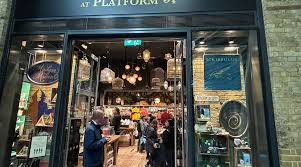
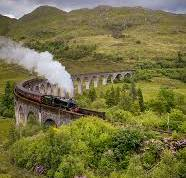
William (looks at the station). “Maybe their cars, roads and airports are small. But their train stations are much bigger than in Texas”.
William (sees a businessman). “Excuse me, you look like a businessman. You ain’t no tourist like me. What are you doing at a train station. Shouldn’t you be at the airport?”
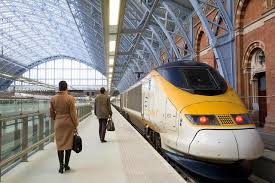
Businessman. “I am going to Paris for a meeting in my company. I am going by high-speed train. It takes a little more than 2 hours. It is a high-speed train running with 186 mph (mph = miles per hour = 300 km/t). All together much faster than going by air. There is a train every hour”.
William. “We try to build a fast train between Dallas and Houston called Texas Central, but until now nothing has happened. Right now there is barely a train a day”.
Businessman. “Try it. There is a buffet car onboard. You can buy snacks, meals, and softdrinks and beer onboard. You could even make a day-trip to Paris with your wife”.
William (thinks): “Hmmm mabye Europe is not that bad …”
Link to the top of the page.
Part 2 The Market
- here we are = egentlig “her er vi”, men i betydningen “endelig er vi her”
- alternative = alternativt
- strange = mærkelige
- stall = stande
- army jackets = millitær jakker, typisk fra et millitært overskudslager
- handmade = håndlavet
- jewelry = juveler
- Keep Austin wierd = ‘behold Austin underlig’. Byen Austin er kendt for at være den absolut eneste venstreorienterede storby i Texas. De andre byer som Dallas og Houston er meget konservative. Austin er stolte af at være “underlige”.
- street food = gademad
- my dear = min kære
- wanna = slang for “want to”
- relax = slap af
- sigh = sukke
- interrupt = afbryde
Later at Camden Town Station
Debbie: “Wow! Here we are. This place already looks very different.”
William: “Look at those buildings and all the street art. This area is really crazy.”
Debbie: “And listen to the music! I can hear rock music from the market.”
William: “Now I understand why people call Camden alternative.”
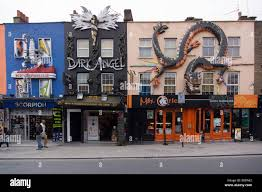

Debbie: “There are so many strange stalls here.”
William: “Yeah. One stall sells old army jackets, another sells punk clothes, and over there they sell handmade jewelry.”
Debbie: “This market is really flipped.”
William: “You mean ‘flipped out’?”
Debbie: “Exactly! It feels very different from Texas except for wired Austin. I wonder if all Europe is like this?”
A stranger: “Excuse me but I can help you. There are a few places in Europe like this mostly in the big cities. I am from Denmark, and Christania in Copenhagen is a bit like here. But Christiania also used to be the distribution centre of hash. Fortunately the police stopped that.”
William: “I am conservative and Texas is very conservative except for Austin. ‘Keep Austin wierd’ they say, so we have that kind of places too. But I must say that I like this place. It feels relaxed and creative.”
Debbie: “Wait a minute… look over there!”
William: “Is that what you think it is?”
Debbie: “Yes! Cowboy hats!”
William: “Ok, but first a beer and some food. We can buy any kind of street food here. There are food stands with food from all over the world. Let’s try some food from India or maybe Thai food. We can go shopping afterwards.”
Debbie: (sighs): “Do we really have to wait, maybe we can drink and eat later on and …”
William: (interrupts) “I promise to go with you afterwards, but these stands made me hungry. So I wanna have something to eat right now. Maybe even a beer. Relax my dear, we have the whole day.”

Link to the top of the page.
Part 3. Haggling
- haggle = at prutte om prisen
- £ = pounds = britiske pund. Egentlig “lispount”, derfor “L”. Og ja, navnet har med vægt at gøre lige som pesos i Latinamerika. Peso = veje, vægt
- expensive, more expensive, most expensive = dyr, dyrere, dyrest
- cheap, cheaper, cheapest = billig, billigere, billigst
- prefer = foretrække
- bargain = prutte om prisen. På markeder som Campden kan man også bruge udtrykket “haggle” frem for bargain

Debbie: “William, look at all these cowboy hats. Let’s compare them and buy the best one.”
William: “Yes, this one is good, but that one looks better.”
Debbie: “I think this brown one is better than the black one.”
William: “But the black one looks like the best of all three.”
Debbie: “Let’s ask the prices. Excuse me, how much does this hat costs?”
Seller: “That one is 50 £.”
Debbie: “That’s about 55 $. That is expensive.”
William: “What about the brown one?”
Seller: “That one is 40 £”
Debbie: “So it is cheaper than the first one.”
William: “Yes, cheaper, but still expensive.”
Debbie: “And the black one?”
Seller: “That one is the most expensive. It is 60 pounds.”
William: “Oh wow, that is the most expensive hat here.”
Debbie: “So the brown one is good, the black one is better, but also the most expensive.”
William: “And the cheapest one is still 40 pounds.”
Debbie: “Yes, I think 40 pounds is better for me.”
William: “Good choice. It is not the best hat, but it is good and cheaper.”
Debbie: “Yes, it is the best price for me.”
William: “Camden Market is really good for comparing prices.”
Debbie: “Yes, better than Selfridges. Much cheaper and more fun.”
William: “For the first time in our marriage I enjoy shopping with you. This is really different. There are even no parking places. But look over there, Debbie! There are more cowboy hats on another stall.”
Debbie: “Oh yes, I see them. Let’s go and check if they are cheaper.”
William: “Good idea. Maybe we can find a better price.”
Debbie: “Excuse me, how much are these hats over here?”
Second seller: “These ones are 55 £ each.”
Debbie: “Hmm… that is more expensive than the first stall.”
William: “Yes, more expensive and not better quality, I think.”
Debbie: “I agree. The first stall was better.”
William: “Let’s go back then. We already found a good price.”
Debbie: “Yes, and I still think 40 pounds was the best deal.”
William: “It is funny. At first we thought everything was expensive, but now we can compare the prices.”
Debbie: “Yes, now I understand: some things are cheap, some are cheaper, and some are the cheapest of course.”
William: “And some are expensive, others are more expensive, and some are the most expensive! But didn’t you prefer the one that costed 55 £”.
Debbie: “You are right”.
William: “Let’s go and ask at the second stand. Maybe we can bargain.” (to the second seller). “Are you ready to give us a good price for 2 cowboy hats”.
Second seller. “Ok, 2 for 80 £. (smiles). But only if you are real cowboys”.
William: “We are from Texas so yes, we are true cowboys and I will buy your hats. Noone in Texas has cowboy hats like that”.
Debbie (smiles): “Wow, I will take you shopping next time. You are really good at bargaining.”
Second seller. “Excuse me, but on markets like this we call it ‘haggling’ not ‘bargaining’.
William: “Fine with me, we can go shopping together. As long as we just go to markets like this. This place is great fun. Good beer and interesting food.”
Link to the top of the page.
Part 4. Catching Up With the Day
catching up with the day = samle op på dagen, vende dagens begivenheder sammen
reconize = genkende
texanian = en person fra Texas
socializing = socialisere
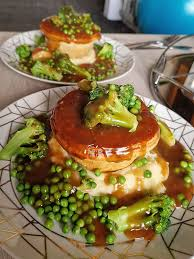
pie = tærte
ale = også ale på dansk eller overgæret øl. Pilsnere er undergæret øl.
mash = mos, typisk kartoffelmos
shepherds’ pie = fårehyrdens tærte. En tærte med hakket fårekød
peas = ærter
onion gravy = brun sovs med løg
Ya got kinda hooked on pubs = You got kind of hooked on pubs = Du er vist blevet varm på pubber
strange = underlig
surprise = overraske
exciting = spændende
neither have I = det har jeg heller ikke
food stalls = boder med mad
man with a full stomach is more agreeable than a hungry man = en mand med en fuld mave er mere medgørlig end en sulten mand
expect = forvente
deserve = fortjene
Debbie and William are now back at the hotel where they are resting after a long day at Campden Market.
William: “It’s time for dinner, let’s go eating. I suggest that we go to the pub where I was yesterday”.
Debbie: “Do they serve food at the pub? I thought that it was only for drinking and socializing.”
William: “They talked about some typical food called pie & mash. I was told that it is a steak and ale or shepherd’s pie, often served with peas and onion gravy.”
Debbie: (smiles) “Ya got kinda hoked on pubs, right? So let me see your place.”
Bartender: (sees William and recognizes him). “Hello texanian. Welcome back. How do you do? Did you bring your wife this time?”
William: “Yes I do. By the way her name is Debbie, mine is William and yours are … “.
Bartender: “Your wife looks lovely, you must be a lucky man. My name is Johnny. My name is very British”.
William: Can we have 2 pie & mash? I would like an ale and you Debbie?”
Debbie: “A cola light please. A big one, I am rather thirsty.”
Debbie: “This has been a really exciting day.”
William: “Yes, it has. I have never visited a place like Camden Market before.”
Debbie: “Neither have I. And we have seen so many strange and interesting things today.”
William: “I think the best part was Kings Cross Station. It’s so old but the trains were real modern. Before we went there, I had never seen Platform 9¾. I didn’t know that it existed in real life at all. It was a good idea to stop there.”
Debbie: “Our grandchild will love the photos. I had already decided to buy him a magic wand before we entered the shop.”
William: “Good thing you did. He has always loved Harry Potter.”
Debbie: “And you were surprised by the trains.”
William: “Absolutely. Before I came to England, I had never understood why Europeans are using trains so much.”
Debbie: “But after you talked to that businessman, you changed your mind.”
William: “Yes. He had already traveled to Paris many times by train. That really surprised me.”
Debbie: “And you started talking about Texas Central again.”
William: “Well, we have tried to build that railway for years, but nothing much has happened. Texas is better at cows and oil than trains.”
Debbie: “Camden Market was fun too. I have never seen so many different food stalls in one place.”
William: “The Indian food was great. I had become really hungry before we found the food stands.”
Debbie: “I know. I had wanted to look at the cowboy hats first”. (smiles). “But I learned from many years of marriage than a man with a full stomach is more agreeable than a hungry man.”
William: “I admit that. And you almost bought the expensive one.”
Debbie: “Yes, but after we had compared the prices, I changed my mind.”
William: “You have become much better at haggling today.”
Debbie: “Thanks to you. Before today, we never tried haggling.”
William: “The seller liked us because we came from Texas. Or maybe he was just a good salesman.”
Debbie: “And maybe he was just friendly. But now we both have new cowboy hats.”
William: “And we have walked for hours. My feet are killing me.”
Debbie: “Mine too. Maybe we should start walking a bit more at home instead of always going by car. But at least we have found a nice pub.”
William: “Yes. I deserve this beer. And you your Cola light.”
Debbie: “Cheers to London and our holiday!”
William: “Cheers!”
Link to the top of the page.
3.1 Questions
Part 1. Going to Campden Market
- Where do Debbie and William want to go?
- What does William want to drink?
- Which transport do they use in London?
- Why is Debbie the “pathfinder”?
- Where do they change trains?
- What famous station is close to Euston?
- What can you do at Kings Cross Station?
- What is Platform 9 3/4 famous for?
- Which book/film is connected to Platform 9 3/4?
- Why do they take photos at the station?
- Who would like the photos the most?
- What does William think about London stations compared to Texas?
- What do they plan to buy at the Harry Potter shop?
- What does Debbie want to buy for their grandchild?
Part 2. The Market
- Where do they arrive after the Underground?
- How does Camden look different from London centre?
- What do they hear at the market?
- Why is Camden called “alternative”?
- What do the stalls sell?
- What kind of clothes are sold at one stall?
- What kind of jackets are mentioned?
- What is handmade at the market?
- What does William think about the market?
- What does Debbie say about Camden Market?
- What food is sold at the market?
- What does William want to do first?
- Why does William want to eat before shopping?
- How does Debbie feel about waiting?
- What does William tell Debbie to do?
Part 3. Haggling
- What do Debbie and William want to buy?
- What are they comparing?
- Which hat does William think is better?
- Which hat does Debbie prefer?
- Which hat looks the best?
- How much is the first hat?
- How much does the brown hat cost?
- How much does the black hat cost?
- Which hat is the most expensive?
- Which hat is the cheapest?
- Which hat is the best price for Debbie?
- Why does Debbie choose the 40-pound hat?
- What does William think about the prices?
- What does Debbie think about Selfridges compared to Camden?
- What does William say about shopping with Debbie?
- What new hats do they find at another stall?
- How much do those hats cost?
- Which stall is better, first or second?
- What does “bargain” mean in the dialogue?
- Why do they go back to the second seller?
- Extra: Explain the difference between haggling and bargainning. Feel free to use ChatGPT to find the answer.
Part 4. Catching Up with the Day
- Why does William suggest going to the pub?
- What does Debbie initially think pubs are mainly for?
- What is “pie & mash” described as in the text?
- How is British “comfort food” described?
- Where are Debbie and William at the beginning of the scene?
- Who recognizes William at the pub?
- What is the bartender’s name?
- How does the bartender greet William?
- What does William order to eat?
- What does Debbie order to drink?
- What does William say about Camden Market?
- What was Debbie’s impression of Camden Market?
- What special place in London surprised William the most?
- What is Platform 9¾, according to the text?
- What did they plan to buy for their grandchild?
- Why did Debbie already decide to buy a magic wand?
- What surprised William about European transport?
- What changed William’s opinion about train travel?
- What activity did Debbie improve at during the trip?
- How do William and Debbie feel at the end of the day?
Link to the top of the page.
3.2 Haggling
Nu skal du selv købe ind på Campden.
A: Spil rollen som en turist, der vil købe en souvenir
B: Spil rollen som sælger
Link to the top of the page.
3.3 Lav et referat
Skriv et referat af, hvad Debbie og William har oplevet.
Link to the top of the page.